Skip to contentInformation for people with disabilityInformation on accessibility

Australian Electoral Commission
Tasmania’s electoral boundaries are set for significant changes at the next federal election, with an electorate name change also being put forward.
The proposed boundaries for Tasmania that were outlined in February have largely been adopted.
Electoral Commissioner Jeff Pope said the changes to Tasmania’s boundaries represent the most significant shifts in recent memory.
“It is quite a fulsome re-drawing of the electoral map for Tasmania’s south that meets the numerical requirements of the Electoral Act and aligns communities of interest as much as possible in those southern electorates,” Mr Pope said.
“It addresses the fact that the electorate of Franklin is currently divided by both the River Derwent and the electorate of Clark, with part of the electorate on Hobart’s Eastern Shore and the rest of it on the other side of the river and covering much of the state’s south.”
“It is a big change supported by the enrolment data, communities of interest, stronger alignment with geographical boundaries and many submissions and public consultation.”
“Overall, the redistribution will result in more than 27 per cent of Tasmanians changing electorate, which equates to around 114,000 people.”
Mr Pope said that public input was an instructive and important part of the redistribution process.
“Throughout the four phases of written input - and the public consultation session - there has been great engagement and suggestions from the public, much of which has been reflected in the eventual outcome,” Mr Pope said.
“We certainly acknowledge the very valid concerns presented by members of the community about Glenorchy shifting electorates, but that change will go ahead.”
“Glenorchy won’t be the only urban part of Lyons with Blackstone Heights and Prospect Vale remaining in Lyons also.”
“The biggest deciding factor is the overarching requirement to ensure electorates remained numerically balanced - Clark couldn’t numerically accommodate the changes required to align communities of interest in the rest of Kingsborough and the Huon Valley, as well as the City of Glenorchy.”
AEC TV video: Tasmanian electorate boundaries announced
The announcement includes a proposal for the electorate of Franklin to be renamed Tongerlongeter.
The proposal to rename Franklin reflects the significant changes that will be made to the electorate’s boundaries, which will now sit exclusively to the east of the River Derwent and encompass much of the southeast of the state.
Tongerlongeter (c. 1790-1837) is recognised by historians as one of the most significant Tasmanian Aboriginal leaders during the early period of British colonisation. As a member of the Oyster Bay nation, Tongerlongeter’s Country is within the proposed boundaries of the electorate.
If this change is adopted, it would be the first time a federal electorate in Tasmania has been named after an Aboriginal person.
No other changes to electorate names are proposed.
The public now has the opportunity to provide written submissions on the proposed electorate name change given it wasn’t included in the original proposal.
“We’re grateful to everyone who took the time to make a submission - Tasmanians’ input on this matter has played a critical role in making decisions on electoral boundaries and the proposal to change an electorate name,” Mr Pope said.
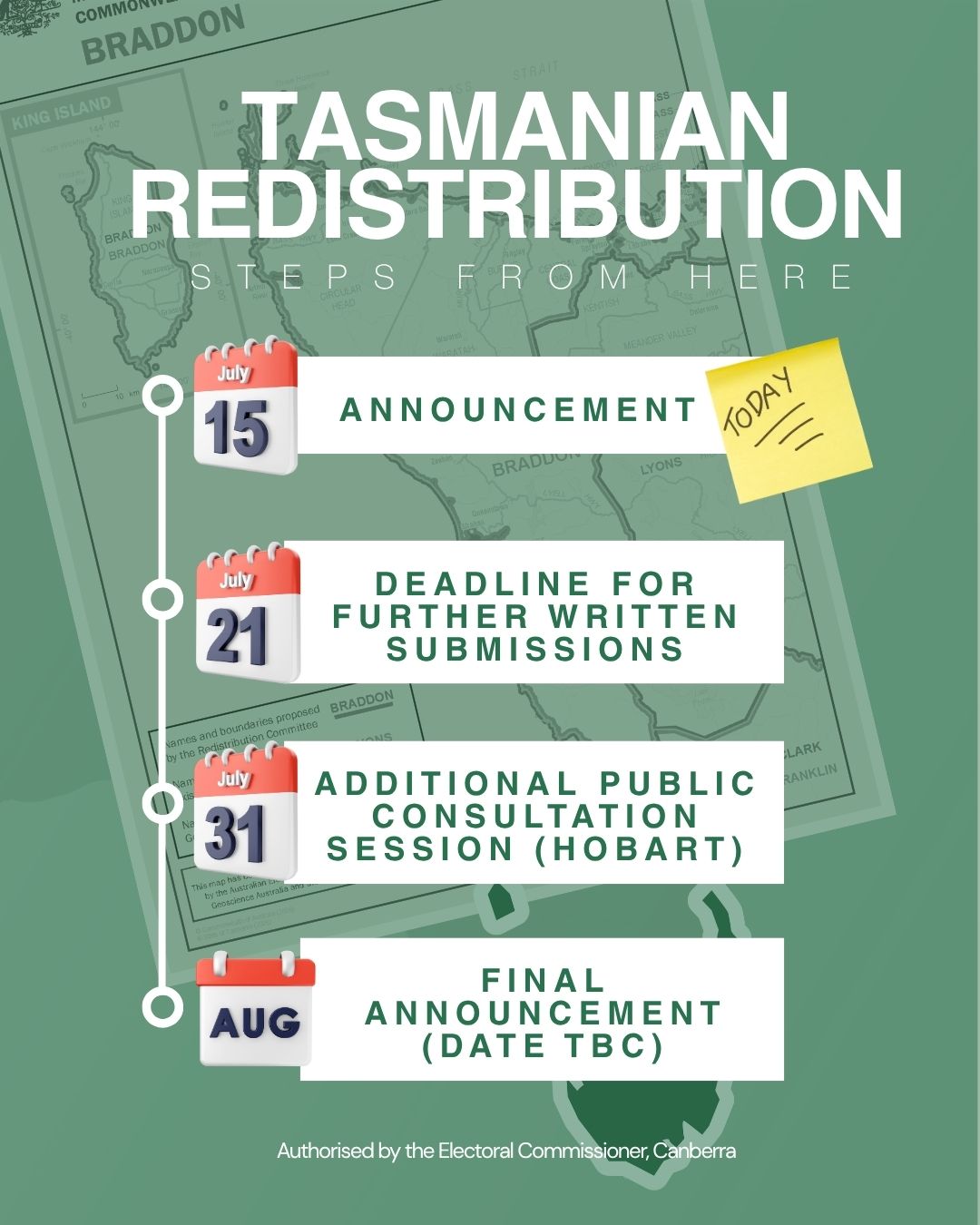
The public have the opportunity to provide written submissions via the AEC website until 11:59 pm (AEST) on Tuesday 21 July 2026. A public consultation session will then be held on 31 July.

The AEC acknowledges the Traditional Owners of Country throughout Australia and recognises their continuing connection to land, waters, culture and community. We pay our respects to Elders past, present and emerging.
