Skip to contentInformation for people with disabilityInformation on accessibility

Australian Electoral Commission
The order of the candidates on the ballot paper for each electoral division is determined by a random draw conducted in the office of the Divisional Returning Officer immediately after the declaration of nominations. The House of Representatives ballot papers are green in colour.
To vote for a Member of the House of Representatives, you are required to write the number '1' in the box next to the candidate who is your first choice, and the numbers '2', '3' and so on against all the other candidates until all the boxes have been numbered, in order of your preference.
Ballot papers must be marked according to the rules for voting so that they do not create informal votes. Ballot papers cannot be counted if they are informal.
Polling officials at the polling place are available to assist voters in completing their ballot paper. If you make a mistake on a ballot paper you may return it to the polling official who issued it and receive a fresh one.
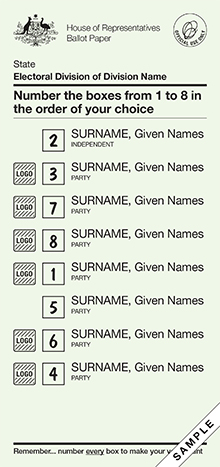
To make a formal vote on a House of Representatives ballot paper, you need to number every box with a series of consecutive numbers according to your preference. You need to:
An informal ballot paper is one that has been incorrectly completed or not filled in at all. Informal votes are not counted towards any candidate but are set aside.
A House of Representatives ballot paper is informal if:
Note: If a House of Representatives ballot paper has all squares numbered consecutively but one, then it is deemed that the unmarked square constitutes the last preference and the ballot paper will be formal.

The AEC acknowledges the Traditional Owners of Country throughout Australia and recognises their continuing connection to land, waters, culture and community. We pay our respects to Elders past, present and emerging.
