Skip to contentInformation for people with disabilityInformation on accessibility

Australian Electoral Commission
Voting is compulsory at all federal elections for Australian citizens over the age of 18.
Polling day is a Saturday and voting takes place between the hours of 8am and 6pm.
Australians can vote by:
Electors making a postal, pre-poll, absent or provisional vote must complete a declaration giving their personal details. This will be checked by the DRO during the counting of votes.
| 1996 | 1993 | 1990 | |
|---|---|---|---|
| Ordinary votes | 86.39% | 87.56% | 87.70% |
| Absent votes | 5.75% | 5.86% | 6.40% |
| Pre-poll, postal and provisional votes | 7.87% | 6.58% | 5.90% |
The electoral systems for the two houses of Australia's federal parliament are different.
Candidates for the House of Representatives are elected using the preferential voting system. This system has been used in federal elections since 1918. Candidates for the House of Representatives stand for a particular electoral division. To be elected, a candidate must get more than half the formal votes cast for that division. Members of the House of Representatives are elected for a three year term.
Candidates for the Senate are elected using a proportional representation system. Candidates for the Senate stand for a State or Territory. To be elected, a candidate must receive a proportion of the votes, also known as the quota. It is a Constitutional requirement that each State be equally represented regardless of its population. There are a total of 76 Senators: 12 for each State and two for each Territory. Senators for each State are elected for a six year term. Senators for each Territory are elected for a term equivalent to the duration of the House of Representatives. Forty Senate vacancies are contested at a half-Senate election. When a double dissolution is declared, all 76 Senate positions are made vacant.
When electors vote they are issued with two ballot papers, a green one for the House of Representatives and a white one for the Senate.
Under the CEA the AEC is obliged to provide separate voting compartments for each voter. This ensures the secrecy of the vote. Each voting compartment must be provided with a pencil. However, voters are able to use their own pen or biro if they wish.
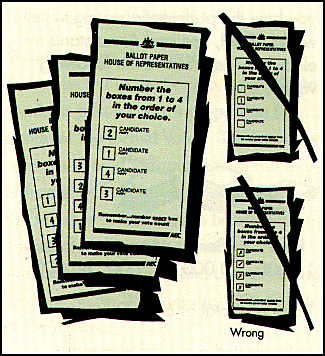
On the ballot paper for the House of Representatives the number '1' is written in the box of the voter's first choice.
Numbering is continued until there is a number in every box.
The ballot paper is folded and placed in the ballot box.
The House of Representatives votes are counted as follows:
 |
|||
| Fred | Ben | Anna | = Total |
| 15 000 | 23 000 | 22 000 | 60 000 |
There is a total of 60 000 votes.
To be elected a candidate needs 30 001 votes (50% plus 1 of the total formal votes).
As noen of the candidates have that many first preference votes, the candidate with the fewest votes, Fred, is excluded and his ballot papers are transferred to the other candidates according to where the number "2's" are marked on them.
 |
||
| Fred | Ben | Anna |
| 15 000 | 23 000 | 22 000 |
| +5 000 | +10 000 | |
| 28 000 | 32 000 | |
Once the second preferences on Fred's ballot papers have been transferred, the votes for each candidate are totalled.
 |
| Anna |
| 32 000 |
Anna is declared the winner
On the Senate ballot paper a voter can either vote above the line or below the line, but not both.
If a voter chooses to vote above the line, the number '1' must be written in one of the boxes above the line. All other boxes on the paper are left blank. If a voter votes in the top section the vote will be counted in the way chosen by the group or party voted for. This is called a group ticket vote and posters are displayed at all polling places showing how each party or group has decided to have their preferences distributed.
At the 1996 federal election 94.4% of voters chose to vote above the line.
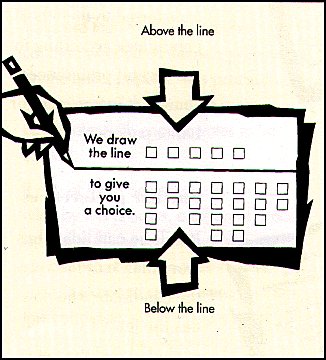
If a voter chooses to vote below the line, all the boxes in the bottom section of the ballot paper must be numbered sequentially in the order of the voter's choice.
| 1990 | 1993 | 1996 | ||||
|---|---|---|---|---|---|---|
| State | GVT Votes | % of all Votes | GVT Votes | % of all Votes | GVT Votes | % of all Votes |
| NSW | 3 147 404 | 94.29 | 3 447 085 | 96.18 | 3 527 343 | 95.8 |
| VIC | 2 325 448 | 90.15 | 2 611 141 | 95.07 | 2 639 537 | 95.4 |
| QLD | 1 523 711 | 91.01 | 1 732 282 | 93.60 | 1 838 928 | 95.6 |
| WA | 833 907 | 91.83 | 927 505 | 95.05 | 946 315 | 94.2 |
| SA | 845 734 | 93.13 | 896 037 | 94.72 | 876 938 | 93.9 |
| TAS | 224 569 | 77.09 | 243 542 | 78.88 | 224 439 | 72.6 |
| ACT | 123 827 | 76.59 | 155 200 | 84.43 | 160 311 | 83.5 |
| NT | 53 131 | 77.31 | 62 486 | 78.95 | 69 749 | 81.4 |
| AUST | 9 077 731 | 91.42 | 10 075 278 | 94.39 | 10 283 560 | 94.4 |
The Senate count is different to the House of Representatives. It is lengthy and complicated. A simplified summary of the main steps follows:
To be elected to the Senate, a candidate needs to gain a certain proportion (or quota) of the formal votes. The quota is calculated by dividing the total number of formal ballot papers by one more than the number of Senators to be elected, and adding 1 to the result (ignoring any remainder). For example, the calculation for New South Wales at the 1996 Senate election was:
3 682 283 + 1 = 526 041
(6 + 1)
Counting the first preference votes
This is done as for a House of Representatives election: the papers are sorted according to the first preferences on each ballot paper. Candidates who receive a quota, or more, of these first preference votes are elected immediately.
Any surplus votes these elected candidates received (i.e. votes in excess of the quota they needed) are transferred to the candidates who were the second choice of voters. However, they are transferred at a reduced value.
As a result of this process of transferring surplus votes, other candidates may be elected. If, however, all surplus votes from elected candidates have been transferred and there are still some unfilled positions, further counting is undertaken.
Starting with the lowest scoring candidate, unelected candidates are excluded from the count and their votes are passed on to the remaining candidates to whom the voters have given their preferences. The above process continues until all Senate positions are filled.
Here's How it Works: To be elected a candidate needs to get approximately 1/7 of all formal votes cast. Some candidates receive more votes than this. They are elected and their surplus votes are passed on to the candidates listed second on the ballot paper. But which ballot papers make up the quota and which are surplus?
All ballot papers are passed on according to the second preferenc shown, but because the first candidate has already 'used up' some of the value of these votes in being elected, the votes flow on to the second preference candidates do not count as full votes. The exact value depends on how many votes the first candidate got: the more votes, the higher the value of the transferred ballot papers.
These 'transferred' votes are added to the second candidate's first preference votes. If those candidates now have more than the quota of votes they need, they are elected. Their surplus votes are then transferred to the candidates listed as the next preference on the ballot papers. This process continues until there are no more candidates with enough votes to be elected.
If any of the 6 Senate places are not filled by this process, a different process is used to fill the remaining places. The candidate with the fewest number of votes is excluded and preferences from this candidate's ballot papers are transferred to remaining unelected candidates. This is done at the value at which the votes were received. When the transfer of these preferences gives a candidate enough votes to be equal to or over the quota, that candidate is elected. The process of excludingthe least popular candidate and transferring surpluses of elected candidates continues until 6 candidates have enough votes, ie a quota, and are elected.'
| State | Enrolment | Formal 1st Pref Votes | Quota |
|---|---|---|---|
| NSW | 3 955 782 | 3 682 283 | 526 041 |
| VIC | 2 972 635 | 2 767 485 | 395 356 |
| QLD | 2 091 384 | 1 924 462 | 274 924 |
| WA | 1 088 487 | 1 004 299 | 143 472 |
| SA | 1 001 006 | 933 776 | 133 397 |
| TAS | 329 304 | 308 970 | 44 139 |
| ACT | 203 170 | 192 057 | 64 020 |
| NT | 98 800 | 85 705 | 28 569 |
Ballot papers correctly marked according to the rules for voting are called formal votes. Ballot papers cannot be counted if they are informal.
A vote above the line will be informal if:
A vote below the line is informal if:
| Senate (%) 1984 – 1996 | |||||
|---|---|---|---|---|---|
| 1996 | 1993 | 1990 | 1987 | 1984 | |
| NSW | 3.8 | 2.7 | 4.2 | 4.9 | 5.2 |
| VIC | 3.6 | 3.1 | 3.6 | 4.0 | 3.7 |
| QLD | 3.3 | 2.0 | 2.5 | 3.1 | 2.7 |
| WA | 3.5 | 2.1 | 2.9 | 3.3 | 4.2 |
| SA | 3.3 | 2.3 | 2.5 | 3.8 | 5.0 |
| TAS | 3.2 | 2.6 | 3.1 | 3.8 | 5.7 |
| ACT | 2.5 | 1.6 | 2.4 | 2.4 | 3.1 |
| NT | 2.8 | 2.8 | 2.8 | 3.7 | 2.8 |
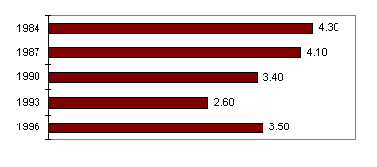
| AUSTRALIA | 3.5 | 2.6 | 3.4 | 4.1 | 4.3 |
| 1996 | 1993 | 1990 | 1987 | 1984 | |
|---|---|---|---|---|---|
| NSW | 3.6 | 3.1 | 3.1 | 4.6 | 5.7 |
| VIC | 2.9 | 2.8 | 3.5 | 5.3 | 7.5 |
| QLD | 2.6 | 2.6 | 2.2 | 3.4 | 4.5 |
| WA | 3.2 | 2.5 | 3.7 | 6.6 | 7.1 |
| SA | 4.1 | 4.1 | 3.7 | 6.8 | 8.2 |
| TAS | 2.4 | 2.7 | 3.3 | 5.0 | 5.9 |
| ACT | 2.8 | 3.4 | 3.0 | 3.5 | 4.7 |
| NT | 3.4 | 3.1 | 3.4 | 5.8 | 4.6 |
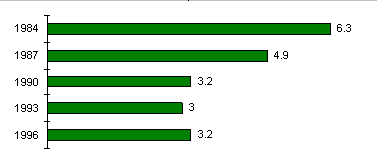
| AUSTRALIA | 3.2 | 3.0 | 3.2 | 4.9 | 6.3 |
A national comparison of informal voting at elections held between 1984 and 1996:

The AEC acknowledges the Traditional Owners of Country throughout Australia and recognises their continuing connection to land, waters, culture and community. We pay our respects to Elders past, present and emerging.